Why Balance Training Changed My Daily Moves—And Can Transform Yours
We often overlook balance until it starts slipping—suddenly, stairs feel trickier, walking on uneven ground wobbles us. I didn’t think about it until a minor stumble made me realize how fragile stability can be. Science shows balance isn’t just for athletes; it’s a core body function that declines with age. The good news? It’s trainable. This article unpacks how targeted exercises can rewire your body’s control system, backed by research and real-life results. What once seemed like an invisible, automatic ability turned out to be a skill I could strengthen—just like any other. And the changes didn’t just reduce my risk of falling. They reshaped how I move through my day, from carrying groceries to chasing after grandchildren. Balance, I’ve learned, is not passive. It’s dynamic, trainable, and essential to living fully at every stage of life.
The Hidden Crisis of Poor Balance
Beyond strength and endurance, balance is a foundational pillar of physical function—yet it often goes unnoticed until something goes wrong. It is the body’s ability to maintain control of posture during stillness and movement, relying on a complex network of sensory feedback, muscular coordination, and brain processing. Unlike more visible fitness goals like toned arms or cardiovascular stamina, balance operates silently in the background, supporting every step, turn, and reach. When it weakens, the consequences can be profound, especially for adults over 40. A sedentary lifestyle, prolonged sitting, and reduced physical variety deprive the body of the micro-challenges it needs to maintain postural reflexes. Over time, these systems dull, increasing the likelihood of missteps and falls.
Research confirms that balance decline begins as early as age 30, progressing gradually but steadily. By the time individuals reach their 50s and 60s, many experience subtle but measurable changes—feeling less steady on their feet, hesitating on curbs, or needing to hold onto railings more frequently. According to data from the Centers for Disease Control and Prevention, one in four adults aged 65 and older falls each year, making falls the leading cause of both nonfatal injuries and traumatic brain injuries in this population. But the risks aren’t limited to physical harm. Fear of falling itself can become a limiting force, prompting people to avoid activities they once enjoyed, such as hiking, dancing, or even walking in crowded spaces. This self-imposed restriction leads to decreased physical activity, which further accelerates muscle loss and balance deterioration—a downward spiral that undermines independence.
What makes this decline so insidious is that it happens quietly, without dramatic warning signs. People may not realize how much they’ve lost until a minor incident—like tripping on a rug or stumbling on a sidewalk crack—reveals the fragility of their stability. The good news is that balance is not a fixed trait. It is a skill that can be improved at any age. Unlike bone density or vision, which are harder to reverse, balance responds remarkably well to targeted training. The key lies in understanding how the body maintains equilibrium and then applying science-based strategies to strengthen it. Recognizing balance as a vital component of health, not just a concern for the elderly, is the first step toward reclaiming confidence in movement.
How Your Body Actually Stays Balanced
Maintaining balance is not a single action but a continuous, dynamic process involving three primary systems: the vestibular system in the inner ear, the visual system, and the proprioceptive system. These systems work in concert, sending real-time data to the brain, which integrates the information to coordinate muscle responses and keep the body upright. Think of it as your body’s internal gyroscope—an invisible but highly sophisticated navigation system that adjusts thousands of times per day without conscious effort. When you tilt your head, shift your weight, or step onto a moving surface, these systems recalibrate instantly to preserve stability.
The vestibular system, located in the inner ear, detects motion and spatial orientation. It senses head movements in three dimensions—up and down, side to side, and rotational—and helps the brain understand whether you are accelerating, decelerating, or standing still. The visual system contributes by providing environmental cues—judging distances, identifying obstacles, and tracking movement. Meanwhile, the proprioceptive system, often called the “sixth sense,” monitors the position and movement of your limbs and joints through sensory receptors in muscles, tendons, and skin. When you close your eyes and touch your nose with your finger, you’re relying on proprioception. Together, these systems form a feedback loop that allows the brain to make micro-adjustments in posture and muscle activation to prevent falls.
However, this system is only as strong as its weakest link. If one component falters—such as blurred vision, inner ear disturbances, or reduced sensation in the feet due to nerve issues—the brain must compensate, often leading to instability. Common physical factors also contribute to poor balance, including weak ankle muscles, stiff joints, and delayed neural responses. For example, if your ankle muscles lack strength or responsiveness, your body may not correct a small wobble quickly enough, increasing the chance of a fall. Similarly, reduced joint mobility in the hips or spine can limit your ability to shift weight smoothly, making movements less fluid and more precarious.
Understanding this integration helps explain why balance training must go beyond simple strength work. It’s not enough to have strong legs if your brain isn’t receiving clear signals from your feet or if your eyes aren’t coordinating with your inner ear. Effective balance improvement requires exercises that challenge all three systems simultaneously, forcing the brain to refine its processing and response times. By engaging in mindful, progressive movements, individuals can enhance the communication between sensory input and motor output, essentially retraining the nervous system to respond faster and more accurately. This neurological adaptation is what makes balance training so powerful—and so accessible to people of all fitness levels.
Why Traditional Workouts Miss the Mark
Most conventional fitness routines prioritize strength, cardiovascular endurance, or flexibility, often overlooking the critical role of neuromuscular coordination. While lifting weights builds muscle and running improves heart health, neither directly trains the brain’s ability to process balance-related signals or coordinate rapid postural adjustments. This gap leaves a crucial component of functional fitness unaddressed. A person may have strong quadriceps and a healthy heart but still struggle to stabilize themselves when stepping off a curb or turning quickly. Research supports this disconnect: studies have shown that individuals with high levels of muscular strength can still exhibit poor balance due to impaired sensorimotor integration—the brain’s ability to interpret sensory data and produce precise motor responses.
The limitation of traditional workouts lies in their predictability. Machines, flat surfaces, and repetitive motions create stable environments that don’t challenge the body’s adaptive systems. In real life, however, movement is rarely so controlled. Walking on uneven terrain, navigating crowded spaces, or recovering from a sudden slip requires reactive control—the ability to respond to unexpected changes in balance. This type of control depends on the nervous system’s speed and accuracy, not just raw muscle power. Without specific training, these reflexive mechanisms remain underdeveloped, leaving individuals vulnerable even if they are otherwise physically fit.
Functional fitness, by contrast, emphasizes movements that mimic daily activities and prepare the body for real-world challenges. It includes tasks like standing up from a chair without using hands, stepping over obstacles, or maintaining stability while reaching for an item on a high shelf. These actions engage multiple systems simultaneously—strength, coordination, balance, and cognitive processing. Balance training is a core component of functional fitness because it directly enhances the body’s ability to perform these tasks safely and efficiently. As people age, the importance of functional fitness grows. Maintaining independence, avoiding falls, and continuing to participate in meaningful activities all depend on the ability to move with confidence and control.
Recognizing the limitations of traditional exercise opens the door to a more comprehensive approach to health. Incorporating balance training doesn’t mean abandoning strength or cardio—it means enhancing them. By adding exercises that challenge stability, individuals create a more resilient, adaptable body. The shift is not about replacing familiar routines but expanding them to include the missing piece: neuromuscular precision. This holistic strategy supports long-term mobility and reduces the risk of injury, making everyday life not just safer but more enjoyable.
The Science-Backed Shift: Train Your Nervous System
One of the most empowering discoveries in modern neuroscience is neuroplasticity—the brain’s ability to reorganize and strengthen neural pathways throughout life. This concept applies directly to balance training. Just as learning a new language or skill reshapes the brain, practicing balance exercises can enhance the neural circuits responsible for coordination and stability. The nervous system adapts to repeated, mindful challenges by improving the speed and accuracy of sensory processing and motor responses. This means that even individuals who have experienced balance decline can regain significant function through consistent, targeted practice.
Clinical studies have demonstrated remarkable improvements in balance among older adults following structured training programs. In one randomized controlled trial published in the Journal of the American Geriatrics Society, participants aged 65 and older engaged in balance exercises three times per week for 12 weeks. By the end of the program, many showed stability levels comparable to those of much younger individuals. Gait speed improved, postural sway decreased, and confidence in daily movement increased. These gains were not the result of intense workouts but of short, deliberate sessions focusing on controlled movements and sensory challenges. The key was consistency—daily practice, even in small doses, led to measurable neurological adaptation.
What makes balance training uniquely effective is its ability to stimulate neural growth through low-intensity but high-precision tasks. Simple actions like standing on one leg, closing the eyes during a stance, or standing on a foam pad introduce controlled instability. These challenges force the brain to rely more heavily on proprioception and vestibular input when visual cues are reduced. Over time, this strengthens the connections between sensory organs and motor neurons, refining the body’s response to imbalance. The principle is similar to how musicians develop fine motor control through repetition—the nervous system learns to anticipate and correct with greater efficiency.
Importantly, intensity is less critical than consistency. Unlike strength training, which often requires progressive overload, balance improvement thrives on regular, mindful engagement. Short sessions of 5 to 10 minutes per day are more effective than occasional longer workouts. The brain benefits from frequent reinforcement, gradually building automaticity. This makes balance training highly accessible—no gym membership, special equipment, or high fitness level is required. Whether standing on one foot while brushing teeth or practicing heel-to-toe walks in the living room, small habits accumulate into lasting neurological gains. The message is clear: balance is not a gift of youth but a skill that can be cultivated at any age.
4 Foundational Exercises That Actually Work
Building better balance starts with simple, evidence-based exercises that target the core systems of stability. These foundational movements are designed to be safe, effective, and easy to integrate into daily life. Each exercise trains a specific aspect of balance while promoting neural adaptation. When performed regularly with proper form, they lay the groundwork for greater confidence and mobility.
The first exercise is the single-leg stance. Stand near a sturdy surface like a kitchen counter or wall, feet hip-width apart. Shift your weight onto one leg and slowly lift the other foot off the ground, keeping the knee slightly bent. Hold the position for 20 to 30 seconds, focusing on keeping your hips level and your core engaged. This movement strengthens ankle stability and improves proprioception. To increase difficulty, try releasing your hand from the support or closing your eyes. Beginners should aim for three sets on each leg daily, gradually increasing hold time as control improves.
The second exercise, the tandem walk, mimics the precision needed for narrow pathways. Walk in a straight line, placing one foot directly in front of the other so that the heel of the forward foot touches the toe of the back foot. Keep your gaze forward and arms relaxed at your sides. This trains dynamic balance and coordination, challenging the body to maintain alignment while moving. It also enhances spatial awareness and foot placement accuracy. Practice for 10 to 15 steps at a time, using a wall for light support if needed.
The third exercise, the heel-to-toe stand, builds static stability. Stand with the heel of one foot touching the toes of the other, arms at your sides or lightly touching a support. Hold for 20 to 30 seconds, then switch foot positions. This position narrows the base of support, increasing demand on the postural muscles and sensory systems. It’s particularly useful for improving control during tight spaces or uneven surfaces.
The fourth exercise, weight shifts, enhances side-to-side stability. Stand with feet shoulder-width apart and slowly shift your weight to the right, lifting the left heel slightly off the ground. Hold for a few seconds, then shift to the left. This movement strengthens hip abductors and improves lateral control—essential for recovering from side slips. Perform 10 to 15 repetitions per side, keeping movements slow and controlled. For added challenge, reduce hand support or increase the range of motion. These four exercises form a powerful toolkit for building foundational balance, preparing the body for more advanced challenges.
Adding Challenge: Progressions for Real-World Resilience
Once the foundational exercises become comfortable, introducing progressive challenges ensures continued improvement and real-world applicability. The goal is not just to stand still but to prepare the body for unpredictable situations—like stepping on ice, avoiding a pet underfoot, or recovering from a sudden push. Advanced variations increase the demand on the nervous system by reducing stability, limiting sensory input, or adding movement complexity.
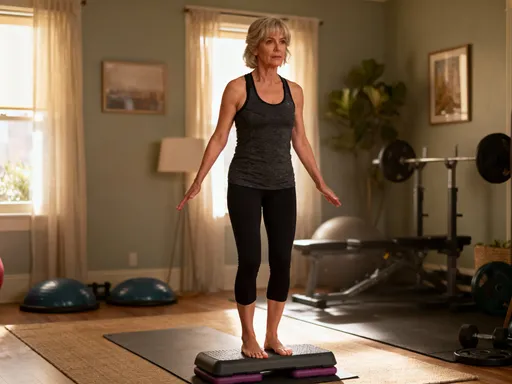
One effective progression is using an unstable surface, such as a foam pad or folded towel. Standing on foam while performing a single-leg stance forces the body to make constant micro-adjustments, enhancing proprioceptive feedback and ankle strength. Another option is closing the eyes during a balance exercise, which removes visual input and increases reliance on the vestibular and proprioceptive systems. This simulates real-life scenarios where lighting is poor or attention is divided, such as walking in a dim hallway or multitasking while moving.
Adding head turns during a tandem stance or walk further challenges the vestibular system. As the head moves, the inner ear must continuously recalibrate, testing the brain’s ability to maintain balance amid changing sensory signals. Dynamic movements like lunges with rotation—stepping forward into a lunge while gently twisting the torso—integrate balance with strength and coordination, mimicking actions like reaching for a suitcase in the backseat of a car. These exercises bridge the gap between isolated training and functional movement.
It’s essential to progress gradually. Rushing into advanced variations without mastering the basics can increase fall risk and discourage consistency. The rule of thumb is to advance only when an exercise feels stable and controlled for the full duration. Incorporating balance drills into existing routines enhances adherence—try standing on one leg while brushing teeth, doing weight shifts during phone calls, or practicing tandem walks in the hallway. These small habits make training sustainable and effective. Over time, the body learns to respond faster, move with greater precision, and recover more easily from disturbances—transforming everyday motion into a confident, fluid experience.
Making It Stick: Habits, Mindset, and Long-Term Gains
The true value of balance training lies not in short-term improvement but in long-term integration. Like any skill, balance requires consistent practice to maintain and build upon. The most effective approach combines behavioral strategies with a mindset shift—viewing balance not as a problem to fix but as a lifelong investment in mobility and independence. Research shows that individuals who incorporate balance exercises into daily routines report not only better physical control but also increased confidence, reduced fear of falling, and greater participation in social and recreational activities.
Habit stacking—linking a new behavior to an existing one—can dramatically improve adherence. Pairing balance practice with routine activities, such as waiting for the kettle to boil or standing in line, turns idle moments into opportunities for training. Setting reminders, using a calendar tracker, or joining a community class can provide structure and motivation. Over time, these small actions accumulate into lasting change. The brain adapts not just during exercise but through repetition, embedding new movement patterns into automatic behavior.
Perhaps the most profound benefit of balance training is its preventive power. Unlike reactive medical interventions, this form of exercise reduces the risk of injury before it occurs. By strengthening the body’s ability to respond to imbalance, individuals protect themselves from falls, maintain independence longer, and preserve the freedom to engage in meaningful activities. It’s not about achieving athletic performance but about safeguarding the simple joys of daily life—walking the dog, playing with grandchildren, or strolling through a park without hesitation.
Balancing training, when embraced as a regular practice, becomes more than physical exercise. It fosters mindfulness, body awareness, and a deeper connection to how we move. It transforms the way we experience space, stability, and control. For women in their 30s, 40s, 50s, and beyond, this is not just about aging gracefully—it’s about living fully. The body is designed to adapt, and with the right training, balance can remain a reliable ally for decades to come. By starting today, even with just a few minutes a day, anyone can build a stronger, more resilient foundation for the life they want to live.